Wow! The Vegetable Orchestra performs on instruments made of fresh vegetables. It was founded in 1998 and is based out of Vienna.
According to the website, at the conclusion of each performance, the audience is offered bowl of vegetable soup.
Sunday, December 9, 2007
Saturday, December 8, 2007
oxford word of the year: locavore
Well, the New Oxford American Dictionary recently announced its "Word of the Year."
Ready?
It's "locavore."
A "locavore" buys food from farmers’ markets or grows the food him- or herself. This is partially because locavores claim local food tastes better and is healthier, but also to avoid the environmental costs of shipping food over long distances.
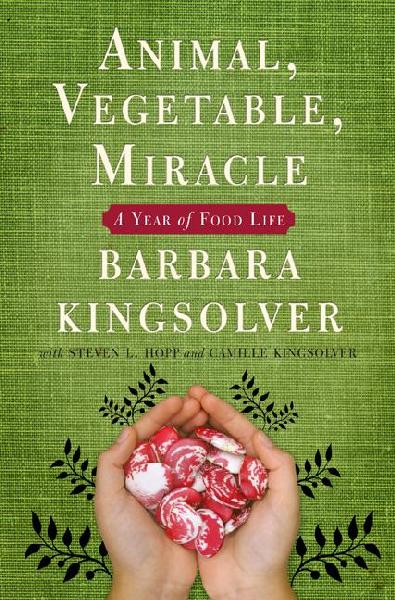 This is especially interesting for me, since I just finished reading Barbara Kingsolver's Animal, Vegetable, Miracle, published in May of this year. A combination of this book and living in California with locavore roommates has ignited my interest in local and seasonal food. The book itself chronicles one family's experience as they move to Appalachia to experiment with eating locally for one year. I found myself laughing at their adventures with squash surplus and turkey sex. But more importantly, I found myself thinking about food seasonally and considering the environmental effects of having bananas in December. (Many people want carbon cost labeling on food products.) Most surprisingly, I found myself trying out the recipes at the end of each chapter. And, I ate a persimmon (seasonal in November) for the first time in my life.
Interestingly enough, 2006's Word of the Year was similarly environmentally-themed: carbon-neutral.
Ready?
It's "locavore."
A "locavore" buys food from farmers’ markets or grows the food him- or herself. This is partially because locavores claim local food tastes better and is healthier, but also to avoid the environmental costs of shipping food over long distances.
“The word ‘locavore’ shows how food-lovers can enjoy what they eat while still appreciating the impact they have on the environment,” said Ben Zimmer, editor for American dictionaries at Oxford University Press. “It’s significant in that it brings together eating and ecology in a new way.”
“Locavore” was coined two years ago by a group of four women in San Francisco who proposed that local residents should try to eat only food grown or produced within a 100-mile radius.(I recently ate at a San Francisco restaurant, Fish and Farm, which focuses on sustainable and organic food. Fish and Farm grows all its own herbs and its produce is organic and sourced within a 100-mile radius. Also, whenever possible, so are their meats. )
This is especially interesting for me, since I just finished reading Barbara Kingsolver's Animal, Vegetable, Miracle, published in May of this year. A combination of this book and living in California with locavore roommates has ignited my interest in local and seasonal food. The book itself chronicles one family's experience as they move to Appalachia to experiment with eating locally for one year. I found myself laughing at their adventures with squash surplus and turkey sex. But more importantly, I found myself thinking about food seasonally and considering the environmental effects of having bananas in December. (Many people want carbon cost labeling on food products.) Most surprisingly, I found myself trying out the recipes at the end of each chapter. And, I ate a persimmon (seasonal in November) for the first time in my life.Interestingly enough, 2006's Word of the Year was similarly environmentally-themed: carbon-neutral.
Being carbon neutral involves calculating your total climate-damaging carbon emissions, reducing them where possible, and then balancing your remaining emissions, often by purchasing a carbon offset: paying to plant new trees or investing in “green” technologies such as solar and wind power.
Monday, November 5, 2007
global warming halloween costume
So, this was my first Halloween at an elementary school, and it was a day of wacky celebration. My favorite costume was that of a fellow science teacher.
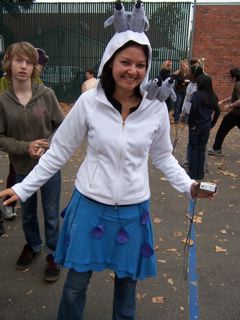 FRONT: You can see the drips on her skirt, the clue that this wasn't your everyday glacier costume. Even though scientists predict that melting ice will not threaten coastal communities for some time, there is incontrovertible evidence that ice is melting at a rapid rate. "Last year Eric Rignot ... calculated that Greenland lost a total of 54 cubic miles (225 cubic kilometers) of ice in 2005, more than twice as much as ten years ago—and more than some scientists were prepared to believe."
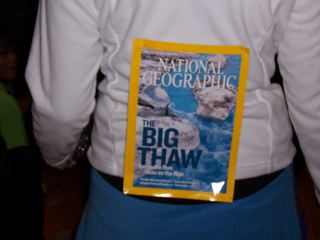 BACK: On her back, she displayed the June 2007 issue of National Geographic entitled The Big Thaw (The magazine also has a pretty cool interactive site where you can learn more about global warming.)
It's very interesting teaching in a Berkeley, CA school. The other day, I showed the 3rd grade class part of a YouTube video to introduce them to Rube Goldberg. I explained that I was only showing part of the video, since it was actually a 1940s advertisement for gasoline. ("Fortunately for us, man has discovered a virtually unlimited source of power... gasoline") I mentioned that I thought is was amazing that just 50-some years ago, there was such positive excitement around using oil.
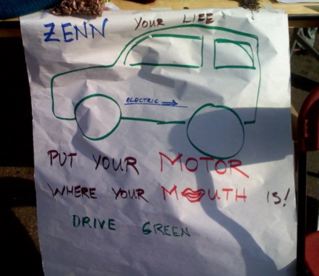
One third grader raised his hand and said, "That's funny because in 2007 we know that burning gas causes pollution and that pollution affects the atmosphere, which causes global warming. So, the ice is melting in places around the world, and some polar animals are losing their habitats." Many kids nodded along. He continued, "But, my family has a hybrid car, so we are trying to make the problem a little bit better." After a bit of discussion, I learned that over HALF of the students had at least one car in the family that was a hybrid, electric, or ran on natural gas. Which reminds me of a sign I saw this weekend at a Berkeley street fair.
FRONT: You can see the drips on her skirt, the clue that this wasn't your everyday glacier costume. Even though scientists predict that melting ice will not threaten coastal communities for some time, there is incontrovertible evidence that ice is melting at a rapid rate. "Last year Eric Rignot ... calculated that Greenland lost a total of 54 cubic miles (225 cubic kilometers) of ice in 2005, more than twice as much as ten years ago—and more than some scientists were prepared to believe."BACK: On her back, she displayed the June 2007 issue of National Geographic entitled The Big Thaw (The magazine also has a pretty cool interactive site where you can learn more about global warming.)It's very interesting teaching in a Berkeley, CA school. The other day, I showed the 3rd grade class part of a YouTube video to introduce them to Rube Goldberg. I explained that I was only showing part of the video, since it was actually a 1940s advertisement for gasoline. ("Fortunately for us, man has discovered a virtually unlimited source of power... gasoline") I mentioned that I thought is was amazing that just 50-some years ago, there was such positive excitement around using oil.
One third grader raised his hand and said, "That's funny because in 2007 we know that burning gas causes pollution and that pollution affects the atmosphere, which causes global warming. So, the ice is melting in places around the world, and some polar animals are losing their habitats." Many kids nodded along. He continued, "But, my family has a hybrid car, so we are trying to make the problem a little bit better." After a bit of discussion, I learned that over HALF of the students had at least one car in the family that was a hybrid, electric, or ran on natural gas. Which reminds me of a sign I saw this weekend at a Berkeley street fair.
Wednesday, October 31, 2007
Saturday, October 13, 2007
sign: shoplifters will be composted
Only in California...
This sign was nestled in the boxes of dates at the Farmer's Market one Saturday morning.
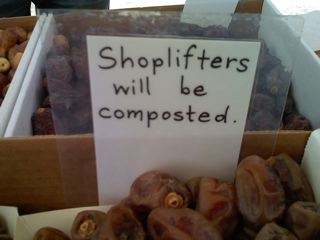
This sign was nestled in the boxes of dates at the Farmer's Market one Saturday morning.
Monday, October 8, 2007
Saturday, October 6, 2007

Thursday, October 4, 2007
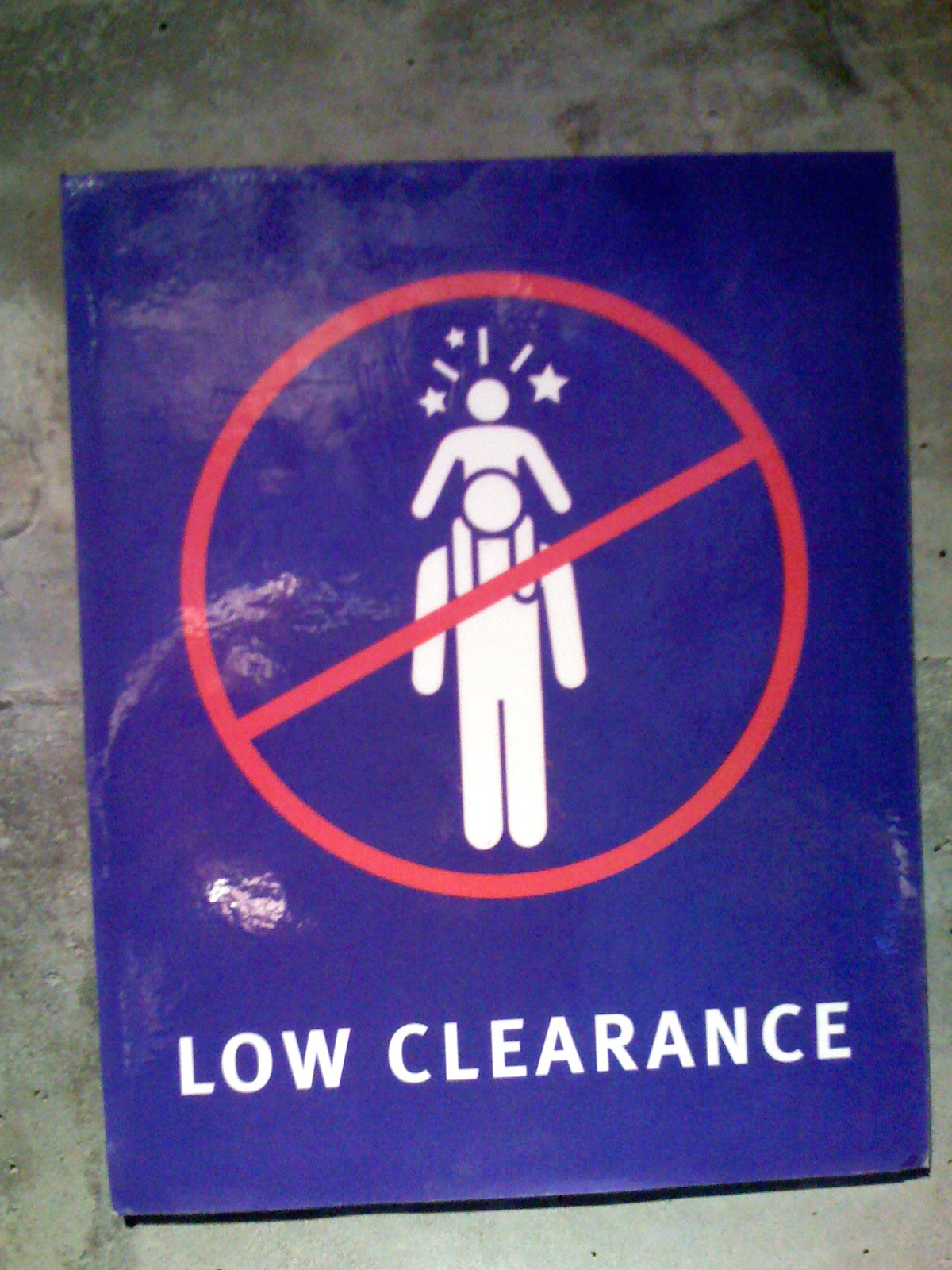
sign: low clearance
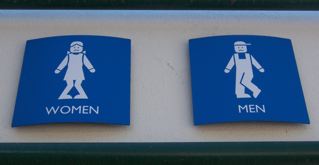
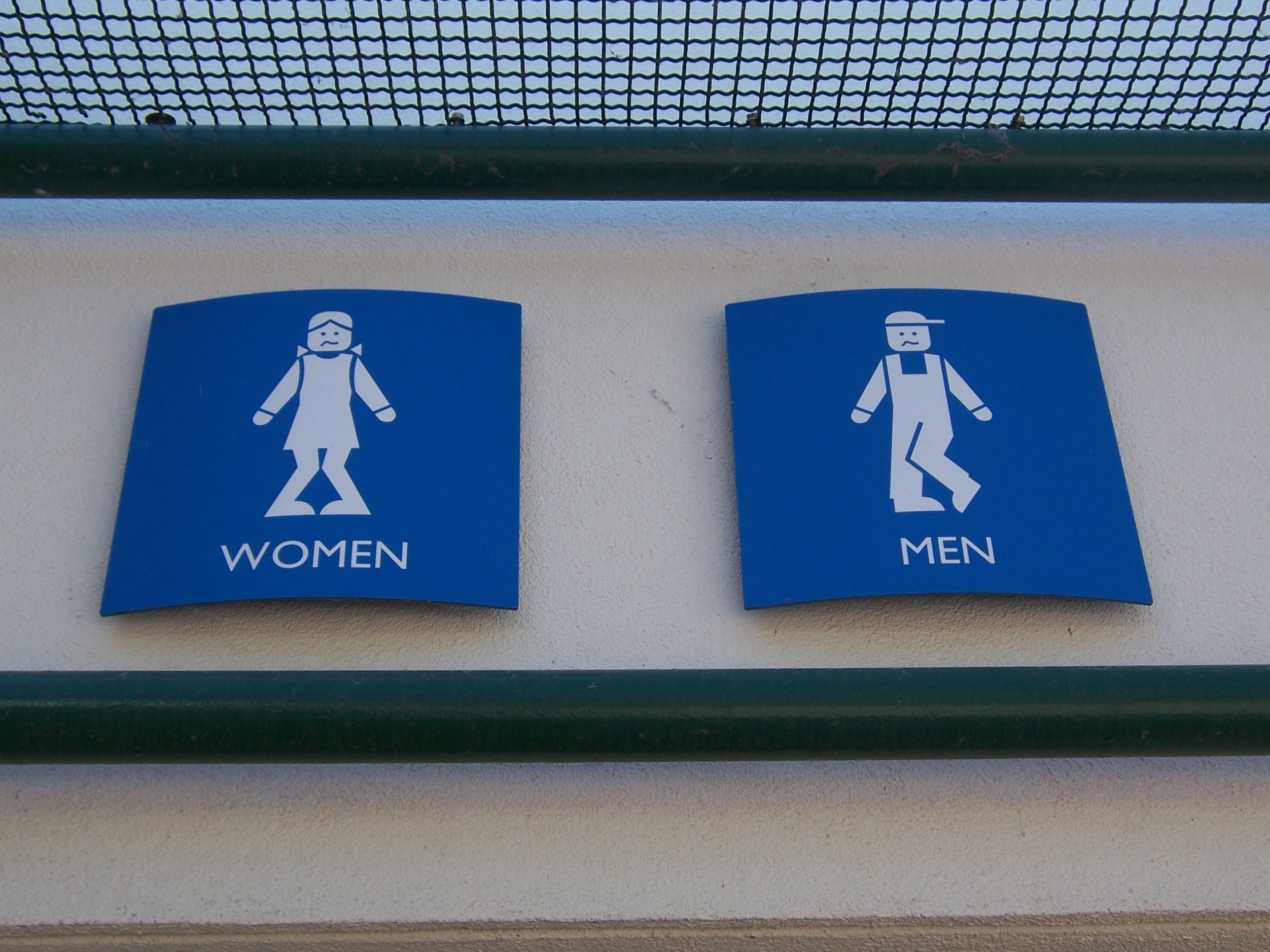
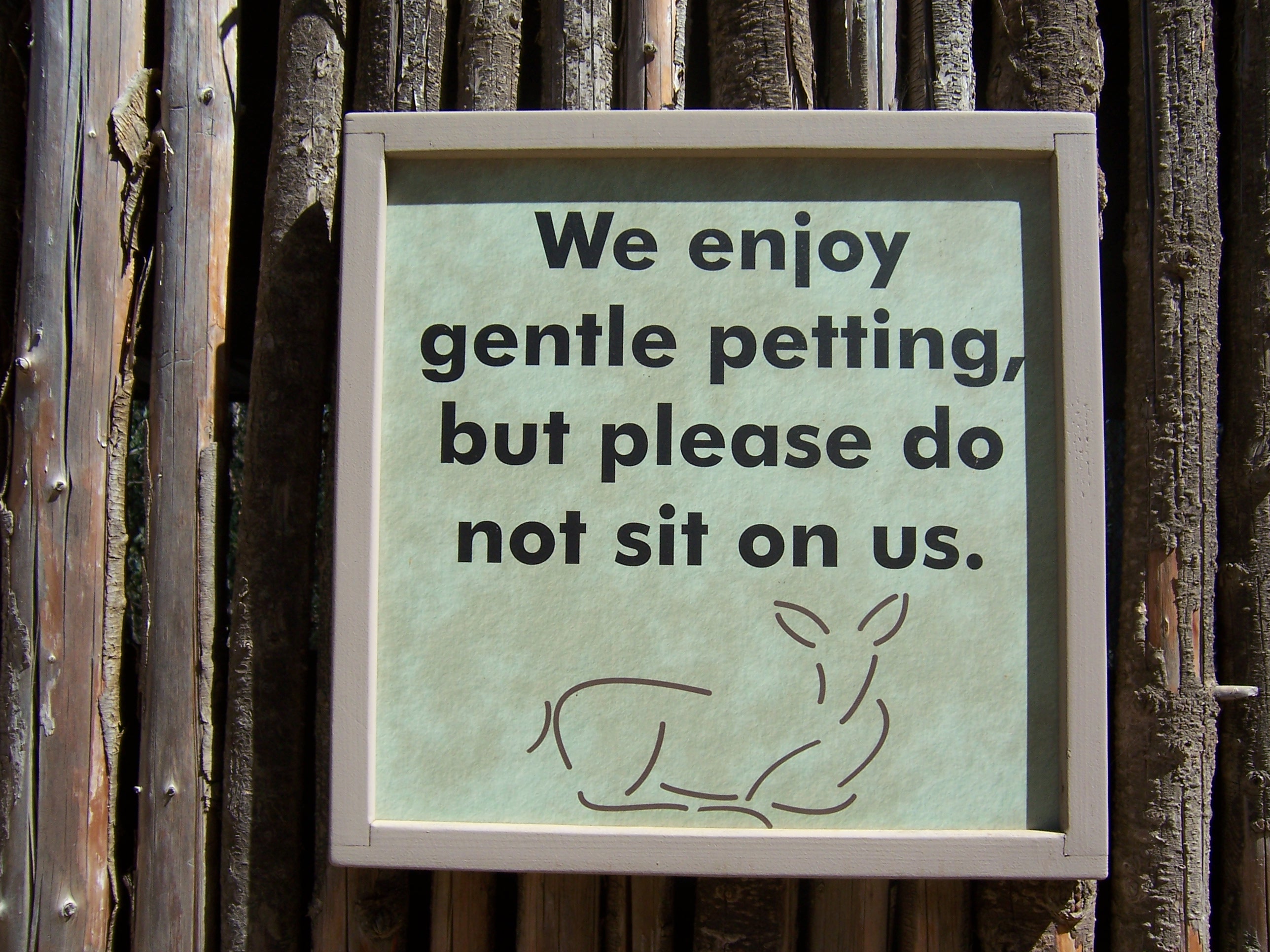
Sometimes you come across signs that can't help but make you laugh. I've decided to include these nuggets of amusement in their very own blog category.
This first sign is found in the California Academy of Sciences museum in San Francisco, CA.
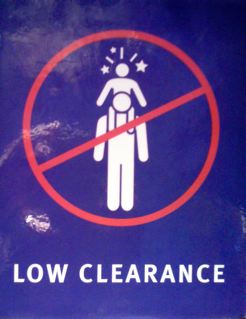
This first sign is found in the California Academy of Sciences museum in San Francisco, CA.
Subscribe to:
Posts (Atom)