Showing posts with label animals. Show all posts
Showing posts with label animals. Show all posts
Monday, January 20, 2014
an incredible animation of the development of a chicken embryo inside the egg
Days 1 through 21 - awesome!
Sunday, September 29, 2013
chicken head tracking
There few things I enjoy more than chicken head tracking. Check out this new Mercedes-Benz commercial! Apparently, the video is highlighting the The Magic Body Control system which combines the "advantages of the Active Body Control (ABC, which is an active suspension system) with the newly-developed Road Surface Scan function, which is a stereo camera that scans the road ahead and prepares the car's suspension for uneven surfaces." (If you are interested in the car-related stuff, you can read more here.) But, on to chickens...
Here's perhaps the most "famous" chicken-head tracking video:
Here's a post on npr where Krulwich ponders this same topic. I tried to find some scientific sources to explain why this happens, the closest I found was an article entitled "How some birds keep their eyes on the prize" (which was eventually published) explaining the "aerodynamic trick [which] enables a bird to attain stabilized vision beneficial for the inspection of the environment."
Apparently, NASA originally did research on the vestibular sensory system of owls, back when they were looking at the effects of space travel on humans. As this post does a good job explaining,
The vestibular system, located in the inner ear, is used by many vertebrates to maintain their sense of balance. It is comprised of three semi-circular canals that contain small "rocks", properly known as otoliths. Together, they provide information to the brain about the movement and location of one's head and body in space.

It works like this: the three semicircular canals sense rotational movements and the otoliths sense linear accelerations. This information is integrated by the brain and used to help control eye movements so we don't become dizzy and to help our postural muscles keep us upright.So, humans participate in head-tracking, too, but birds (and some other animals) are just ridiculously good at it. (The aforementioned post also includes an owl-head tracking video, compliments of this NASA research.) You can read WAY more about the inner ear and your vestibular system on this NASA page.
Finally, according to some sources, the chicken head tracking commercials are not all that original.
Saturday, August 27, 2011
colorful ant abdomens & honeypot ants
 Recently, the UK Daily Mail featured this article about a colorful insect experiment! You can also click on either of the first two photos to be taken to the article.
Mohamed Babu is a scientist from South India. One day, his wife showed him some ants had turned white after drinking spilt milk. This gave him an idea!
Babu mixed the sugar drops with edible red, green, blue and yellow dyes and placed them in his garden to attract the insects. (He used a paraffin base for the drops, so that they kept their shape when touched by the ants.)
I can only imagine his glee when the ants abdomens began to turn the colors of the drops!

He noticed that the ants seemed to prefer the lighter colors - yellow & green - to the darker colors, red & blue.
This experiment reminds me of an excellent question from a student one day in science class long ago. My student asked,
We've learned that all arthropods have a tough outer covering called an exoskeleton. However, we have also learned that some arthropods, such as "honey-pot" ants and ticks actually expand as they collect honey or blood in their body. Is the exoskeleton able to expand? Do these organisms have a different type of exoskeleton that other arthropods?
I didn't know the answer so, as usual, I asked the UCSB ScienceLine (a GREAT resource for science teachers or other curious folks). You can still see the question since it is archived on the site. A couple of scientists explained how exoskeletons are actually made of hard plates joined by soft areas, much like the pads on a baseball catcher. When the honeypot ants do their thing, the soft parts stretch, but the hard parts stay the same size. The scientists point out that the exoskeleton is "now useless at protecting the ant, but the full ants just stay inside the nest where they are fairly safe."
There are somewhere around 30 different species of honey pot ants, and they most often live on the edges of deserts in Western America, Mexico, Australia, South Africa and New Guinea. During the rainy season, particular worker ants (called repletes) drink up the liquid sugar from flowers until they are engorged. Then, during the dry season, they provide food for the rest of the colony by regurgitating a little bit at a time. You can see a great picture of a single ant here. Even NASA.gov has a blog post about these wonderful ants which includes a recording of a conversation with a scientist who knows a lot about ants - he is working on classifying all of the ants in the world!
Just for kicks, here is a CC pic of some full honey pot ants!


Friday, April 23, 2010
chicken blog!
So, the other day, I read this great post about a rescued chicken. Who knew 100 chickens a year were abandoned in San Francisco each year? Well this one, named Elvira, was one of the lucky ones to find a home with a woman in the Mission neighborhood.
What's even better? The new owner maintains a CHICKEN BLOG! Awesome. On her first post, in March 2010, she writes, "Not to be hip is embarrassing. Especially in the Mission, which is a nursery for many Silicon Valley success stories, and thus, home for hip people. To be somebody in this neighborhood, I need the chickens."
What's even better? The new owner maintains a CHICKEN BLOG! Awesome. On her first post, in March 2010, she writes, "Not to be hip is embarrassing. Especially in the Mission, which is a nursery for many Silicon Valley success stories, and thus, home for hip people. To be somebody in this neighborhood, I need the chickens."
Tuesday, March 23, 2010
Monday, January 18, 2010
will you help?
The Boston Globe did a photojournal of the 2009 Sumatra earthquake. I've been holding on to this image for a while, and debating whether or not to post it. The picture below usually would make me laugh (since ducks are hilarious), if it wasn't so sad (salvaging what he can from the destruction).
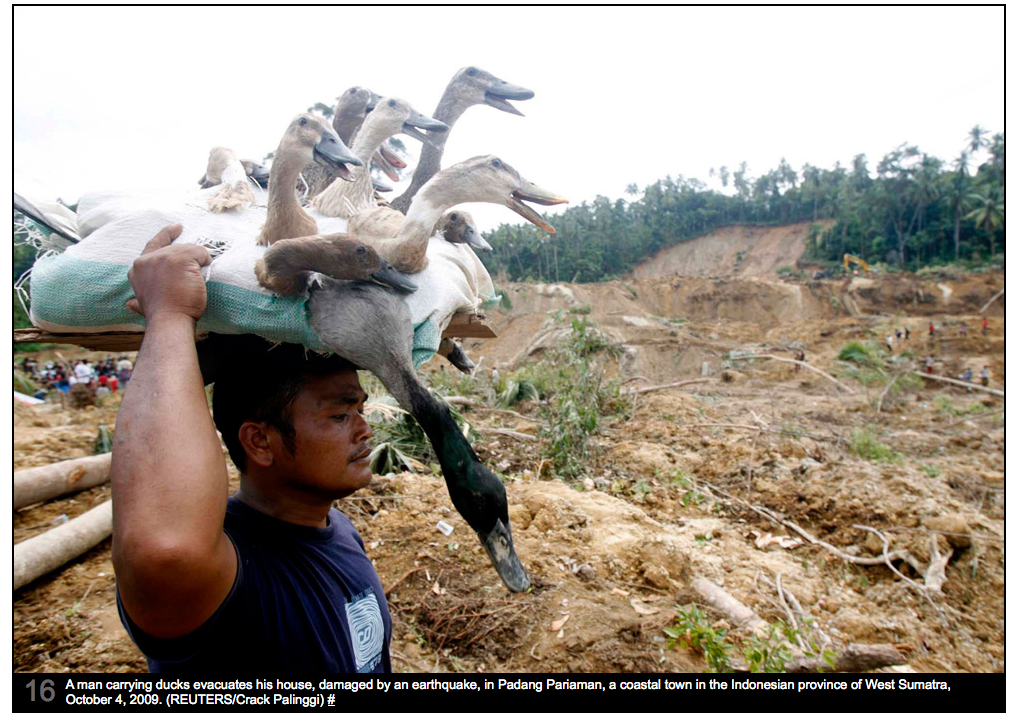 Events like these in Sumatra, and most recently in Haiti, remind us of the power of nature, as well as the good fortune so many of us enjoy.
If you haven't already, please consider making a donation to the Red Cross. You can text "HAITI" to 90999 and make a $10 donation to support the American Red Cross Haiti relief efforts. The donation will be debited from your cell phone bill.
Update 5:20pm: I have been alerted to the fact that these mobile donations can take up to 90 days to reach the Red Cross (CNN, Gigaom). Jonathan Aiken, spokesman for the Red Cross, says "The Red Cross already has cash on hand, so it's putting that money to work now and will replenish its coffers once the mobile donations are officially processed... That's how it's always worked," Aiken said. "So in a way it doesn't matter which exact date the money officially comes in. And in any case, we're still going to be in Haiti 90 days from now -- this is not going away anytime soon."
The Better Business Bureau recommends that consumers give to charity online, by phone or mail if they want the funds deposited immediately.
Events like these in Sumatra, and most recently in Haiti, remind us of the power of nature, as well as the good fortune so many of us enjoy.If you haven't already, please consider making a donation to the Red Cross. You can text "HAITI" to 90999 and make a $10 donation to support the American Red Cross Haiti relief efforts. The donation will be debited from your cell phone bill.
A 48-hour-old fundraising campaign to help Haiti earthquake victims, done solely through text messages, was already stunning Red Cross officials on Thursday when it hit $3 million. By Friday morning, the tally had more than doubled.The campaign, made viral on networking sites like Twitter and Facebook, had raised $8 million by Friday, according to a Twitter message from the White House that was reposted on the Red Cross account. - CNN 1.14.10
UPDATED: Harman said the campaign, which raised more than $3 million in its first 24 hours last week, had topped the $21 million mark by 11 p.m. on Sunday. - CNN 1.18.10
Update 5:20pm: I have been alerted to the fact that these mobile donations can take up to 90 days to reach the Red Cross (CNN, Gigaom). Jonathan Aiken, spokesman for the Red Cross, says "The Red Cross already has cash on hand, so it's putting that money to work now and will replenish its coffers once the mobile donations are officially processed... That's how it's always worked," Aiken said. "So in a way it doesn't matter which exact date the money officially comes in. And in any case, we're still going to be in Haiti 90 days from now -- this is not going away anytime soon."
The Better Business Bureau recommends that consumers give to charity online, by phone or mail if they want the funds deposited immediately.
Saturday, December 26, 2009
profitable reindeer poop
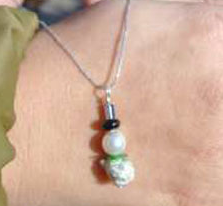 So, don't ever let someone tell you your ideas are silly. This holiday season, Bloomington's Miller Park Zoo has raised $20,884 by selling necklaces and ornaments made from reindeer droppings.
Last year, the zoo made about $5,000 selling reindeer-dropping ornaments. This year, they moved into necklaces after some people asked if jewelery would become available.
To make them, dime-sized pieces of reindeer poop are dehydrated, sterilized and spray-painted with glitter. They're called "Magical Reindeer Gems." (The image above is courtesy of a November post in this cool blog called L.A. Unleashed.)
The ornaments cost $7.50 at the zoo's gift shop or $10 by mail. The necklaces sold for $15 at the gift shop, or $20 by mail. The Miller Park Zoological Society says this year they made about 300 necklaces and more than 2,000 ornaments.
The zoological society says the ornaments and necklaces were sold nationwide. And I LOVE this news bit: "Requests also came in from other countries, but federal regulations don't allow reindeer droppings to be exported." (!)
Unfortunately, these items are limited-edition... so maybe next year?
This story reminds me of another poop fundraiser. I taught high school back in 1999 in central Illinois. It was a learning experience... from kids bringing in their prize-wining goats for their science project to a kid who invited me to ride in his new air-conditioned combine. But, I thought the kids were pulling my leg when they told me about the "Cow Patty Derby."
For this fundraiser, the football field was divided into numbered 1 ft x 1 ft squares. Then people bought corresponding numbered raffle tickets. The night of the event, townsfolk gathered in the bleachers and they let a cow loose on the field. Now, this sounds more dramatic than it is, since the cow mostly just stood there and occasionally walked around. But, eventually, as all cows do, it needed to.. ahem ... relieve itself. So, it drops a cow patty in some random square, and the owner of that numbered ticket is the big winner!
Wednesday, November 25, 2009
turkey pardon
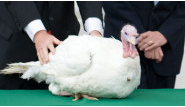 So, I've been meaning to blog this for over a year, ever since I read about George Bush pardoning a turkey. Apparently, Obama will continue the tradition today as he pardons a 45 pound turkey and sends it off to be the Grand Marshall of the Thanksgiving Day parade in Disneyland. According to Snopes, this tradition started with George Bush Sr. in 1989. (President Harry Truman is often cited, incorrectly, as the first president to pardon a Thanksgiving turkey.)
One of my favorite quotes of the event is: "You know there are certain days that remind me of why I ran for this office. And then there are moments like this - when I pardon a turkey and send it to Disneyland."
Watch turkeys Courage and Carolina get their pardons:
Funny... this year, The president of PETA, Ingrid Newkirk has written in a blog for Huffingon Post:
On behalf of People for the Ethical Treatment of Animals (PETA) and our more than 2 million members and supporters, I am writing to ask three things: 1) that you please send this year's pardoned turkeys to a credible sanctuary; 2) that in your speech at the pardoning ceremony, you acknowledge the millions of compassionate Americans who personally pardon turkeys every year by choosing a vegetarian Thanksgiving meal; and 3) that you invite PETA's chef to present a delicious cruelty-free Thanksgiving meal for you and your family, including Tofurky with all the trimmings, from corn bread to cranberries, and an all-American vegan apple pie with vanilla soy ice cream on top. The vegan meal would provide some balance to all the free publicity given to the turkey industry on this occasion.
Friday, September 18, 2009
fish doctor feet
 So, for hundreds of years, people could relax in the hotsprings of Turkey while fish gently nibbled on their skin. Apparently, it is so hot in these springs that not much can grow, so the fish are quite hungry. In comes a human with dry, flaky skin, and the fish see a feast before them. In the 1980's, Turkey began using these "doctor fish" to officially treat skin conditions such as psoriasis and ezcema. In 2008, a salon in Virginia became the first U.S. location to offer the fishy service.
Conveniently, these fish prefer affected skin, and will leave healthy skin alone. The fish can be of two different species: Garra rufa and Cyprinion macrostomus. Many scientists think that as the fish remove your dead, scaly skin, light and water can get to the healthy skin underneath, helping your body heal itself.
It sounds like a joke, but according to one study published by Oxford University Press, "Ichthyotherapy (therapy with the so-called ‘Doctorfish of Kangal’, Garra rufa) has been shown to be effective in patients with psoriasis in the Kangal hot springs in Turkey."
In Kangal, the water's high temperature makes it difficult for any nutrients to survive; the doctor fish are therefore ravenous. Handily, they also have a penchant for dead, diseased or scabby skin. With their gummy mouths they strike and lick the psoriatic plaques, eating away the scaly skin that has been softened by the warm spa pool. Their nibbles can cause minor bleeding, which the selenium-rich water and high-altitude Turkish sunlight then heals. (source)
Click here to watch a BBC news report on a fish doctor spa.
Tuesday, August 4, 2009
snuggies for dogs?!
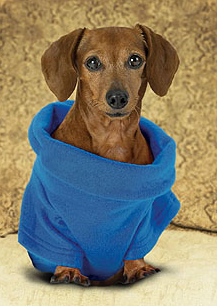 I tried to resist blogging about this, but it is just too funny. I read a Chicago Tribune article informing us that Snuggies are FINALLY available for dogs. (Did I miss something here? Does any dog need a blanket with sleeves?!)
The Snuggie for Dogs is $14.95 plus $7.95 shipping and handling. A second one is free if you pay for shipping.
Then I watched the promotional VIDEO on the website.
I am still laughing....
Friday, June 5, 2009
fragrant whale vomit?
So, I was cruising HowStuffWorks, and a headline caught my eye:
How can whale vomit help me retire?
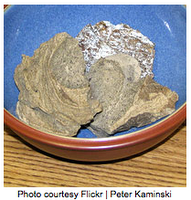 Whoa. Encyclopedia Britannica backs it up: Ambergris is "a solid waxy substance originating in the intestine of the sperm whale. Fresh ambergris is black and soft and has a disagreeable odour. When exposed to sun, air, and seawater, however, it hardens and fades to a light gray or yellow, developing a subtle and pleasant fragrance in the process." An Italian site tells of the powers of ambergris, from its use for pheromones, tea flavorings, and use as an infertility cure.
Experts say you can get about $10 to $20 per gram of ambergris, depending on its quality.
HowStuffWorks offers a few at-home identification tests if you think you may have found aged whale puke:
How can whale vomit help me retire?
Whoa. Encyclopedia Britannica backs it up: Ambergris is "a solid waxy substance originating in the intestine of the sperm whale. Fresh ambergris is black and soft and has a disagreeable odour. When exposed to sun, air, and seawater, however, it hardens and fades to a light gray or yellow, developing a subtle and pleasant fragrance in the process." An Italian site tells of the powers of ambergris, from its use for pheromones, tea flavorings, and use as an infertility cure.Experts say you can get about $10 to $20 per gram of ambergris, depending on its quality.
HowStuffWorks offers a few at-home identification tests if you think you may have found aged whale puke:
Why am I just learning about this? Check out more images of this crazy whale barf.
But there are a couple of tests that you can perform at home to find out if you should even bring that waxy substance to an expert in the first place.If the substance passes those tests, the next ones take place in a lab. Chemists will test for benzoic acid and cholesterol in the sample. If the amounts are indicative of ambergris, it will usually be tentatively confirmed as ambergris at this time, although perfume companies will typically order more chemical tests before purchasing the would-be whale vomit.
- Needle test
Heat a needle over a flame for 15 seconds, and then insert it about an eighth of an inch (.3 cm) into the substance. Does it melt around the needle into a pool of thick, black, bubbling liquid? When you touch that liquid, do you end up with a stringy, tar-like residue on your finger? When you reheat the needle, covered in the melted substance, does it let off a white smoke?- Methyl-alcohol test
Does a sample of the substance dissolve in hot methyl alcohol and crystallize when the alcohol cools?
Sunday, February 1, 2009
a trucker and his duck
A truck driver from Minnesota brings his duck out on the job. The best quote?
"As stupid as it sounds, maybe if more people had a duck in their life... maybe we wouldn't be so mad at each other all the time."
"As stupid as it sounds, maybe if more people had a duck in their life... maybe we wouldn't be so mad at each other all the time."
Friday, January 2, 2009
the elephant diet = no more jelly beans
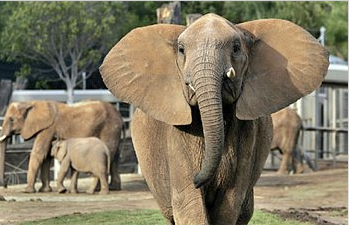 According to A San Diego newspaper, Elephants at the San Diego Zoo and Wild Animal Park have lost a combined total of 11,314 pounds ever since zookeepers began a nutrition and exercise program for them in 2000. The article points out "that's nearly 5.7 tons among seven animals. "
Apparently, zoo keepers started to feed the elephants a number of smaller meals throughout the day, instead of three big meals. They also hid the food so that the animals would "work for it" and trained the animals to walk laps. And they cut out the elephants snacks, including jellybeans.
Mary, one of the Wild Animal Park's Asian elephants, lost weight but couldn't keep it off. Zookeepers didn't understand – until they discovered Mary was stealing food from her pachyderm pals.
Nature is cruel, it seems, even to elephants. The other pachyderms at the Wild Animal Park probably hate the aptly named Cha Cha. Like a supermodel, her trouble is keeping the weight on.
Zookeepers also changed the main ingredient of their elephant pellets to soy.
At the Wild Animal Park, the elephants do the equivalent of line drills in basketball. They've been trained to walk from Point A to Point B across the 3-acre enclosure, then back again.
For an added element of difficulty, zoo workers rake the packed soil so it requires more effort to walk. It's like running in the soft sand at the beach instead of at the waterline.
Monday, September 15, 2008
giant rabbits
 A link from the Chicago Tribune...
Karl Szmolinsky, who raises a breed of rabbits called giant grays, shows Robert, an 8.5kg giant gray who is 74cm long and has ears 25.5cm long, in the backyard of his house in Eberswalde, Germany in 2006. Szmolinsky sold eight giant grays to a delegation from North Korea that wanted to raise the breed as a source of meat for the North Korean population. Szmolinsky said his rabbits reach a maximum weight of 10.5 kg (23.1lbs.).
Monday, April 21, 2008
Sunday, April 20, 2008
hippopotamus art car
 I read a funny article in the SF Chronicle the other day. Apparently, this clown in Houston is obsessed with hippopotami and wanted to turn her Toyota Rav4 into something more hippopotam-ish. Eight years after she first got his name, Tom Kennedy finished her SECOND hippo-mobile!
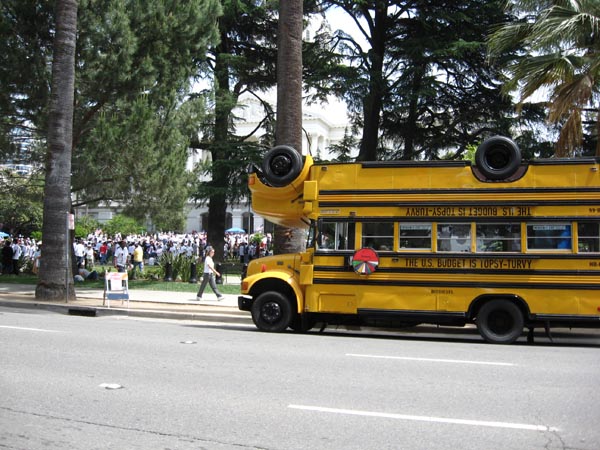
You can check out Tom Kennedy's website for more pictures, plus the story of the upside-down school bus built for Ben Cohen of Ben & Jerry's ice cream!
Friday, March 28, 2008
gummy banana slugs and real slug weirdness
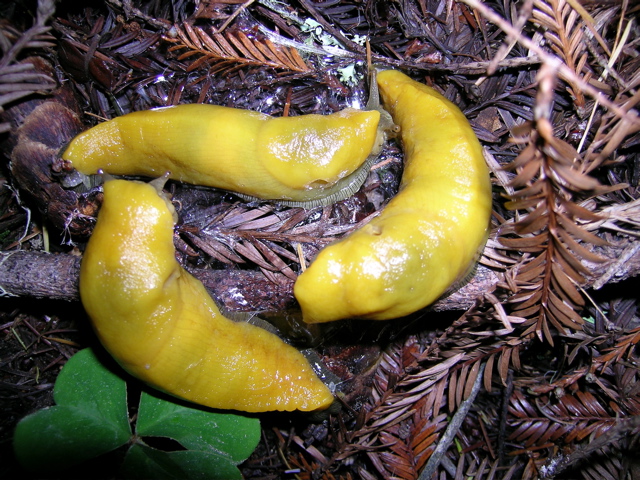 "The banana slug is a bright yellow to olive green-ish, slimy mollusk found in the northwest redwood forests and can grow up to 12". It the official school mascot for UC Santa Cruz."
I love banana slugs. And now, out in California, I actually see them. So imagine my glee when I discovered these gems of randomness.
You can buy a gummy banana slug from Candy Warehouse for $5.90. These sugary wonders are 5.5 inches long and weigh 45 grams. Or get a similarly sized candy mollusk for only $4.75.
But if we are talking random fabulous, buy your gummy slug from McPhee. While you're there, you may want to pick up some meat trinkets including a bacon placemat and assorted meat pencil toppers?! Or pick up an avenging narwhal play set or other bizarre types of candy!
Lake Quinault Lodge even has a stuffed slug?!
As strange as these fake banana slugs may seem, the reality of these mollusks is much, much stranger. Banana slugs, Ariolimax columbianus, are hermaphroditic, which means they have both male and female parts. This is not all that strange in the animal kingdom, especially among invertebrates. However, it's what they do after they mate that is unusual. Slugs generally fertilize each other at the same time, but because they can have rather large reproductive organs, one of the slugs can get stuck. The other slug then does an activity scientifically referred to as apophallation, where they... ahem... gnaw off the other slug's penis to get the slug loose from its mate. While this may sound crazy to us, scientists believe this may serve an important purpose. They slug who loses their male organ is forced to become female and offer up eggs.
Still need more banana slug science? Here's a coloring page.
Thursday, March 20, 2008
boston dynamic's military robot dog!
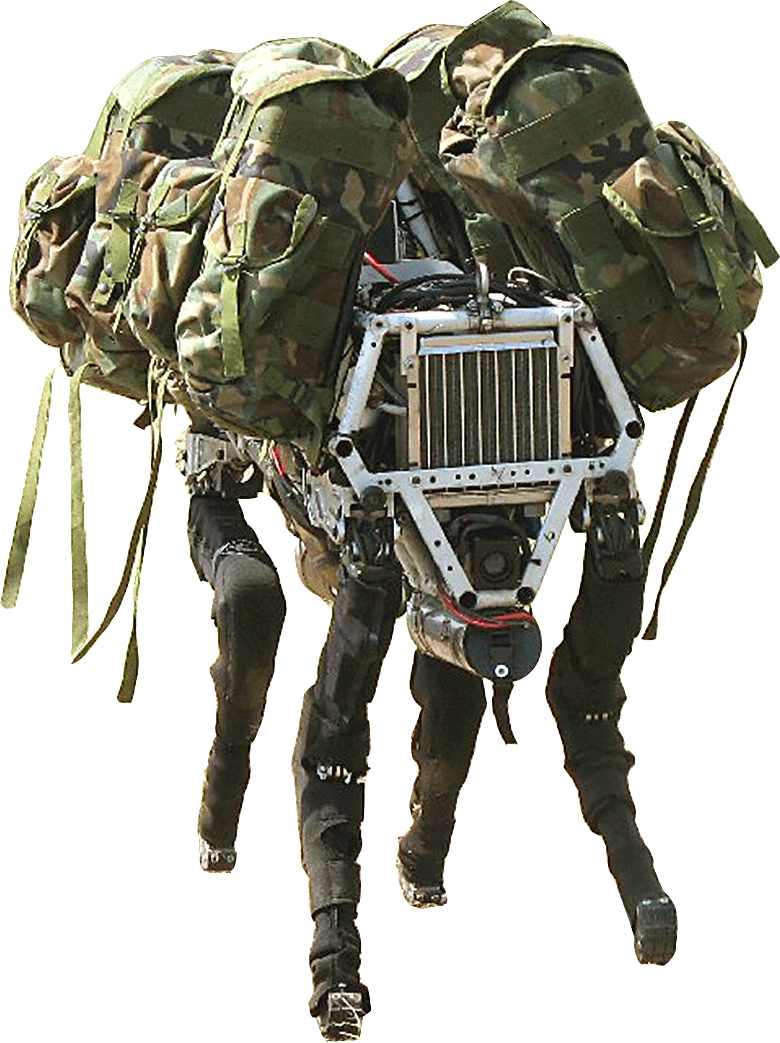 Boston Dynamics, an engineering company that specializes in robotics and human simulation, has created one of the most fascinatingly creepy things I have ever seen - BigDog.
This robot has a strikingly animal-like walk, due to its many sensors that help it judge its position, force and load. In fact, this robot can't be knocked down, although engineers gave it a good kick during the demo video.
BigDog trots at about 4 mph, climbs slopes up to 35 degrees, walks across rough terrain, snow and ice, and carries a 340 lb load. And it is noisy... it sounds like a hive of buzzing bees. BUT - it can carry packs where humans can't or shouldn't go, and won't get spooked by gunfire. And it's come a long way since the 2006 model.
BigDog is being developed with the goal of creating robots that can go anywhere on Earth that people and animals can go. The program is funded by the Defense Advanced Research Project Agency (DARPA). (DARPA is also funding a project to develop a robot that climbs trees?!)
And, of course, as with anything new, somebody's got to make a parody.
UPDATE (Dec 2010): Also very cool is the climbing robot - RISE.
Saturday, March 15, 2008
giant gulping whales
Scientists at the University of British Columbia and the University of California, Berkeley have discovered some amazing things while studying fin whales. First, the gulps of some of these baleen whales can take in a volume of water equal to the size of a school bus. These are no small gulps, especially with jaws that can be up to one-fifth their 88 feet body length!
Baleen whale generally have 200-400 overlapping plates hanging from each side of the upper jaw, where you might expect to find teeth. These plates, called baleen, are made of a fingernail-like material called keratin. "During feeding, large volumes of water and food can be taken into the mouth because the pleated grooves in the throat expand. As the mouth closes water is expelled through the baleen plates, which trap the food on the inside near the tongue to be swallowed." (Info from the American Cetacean Society)
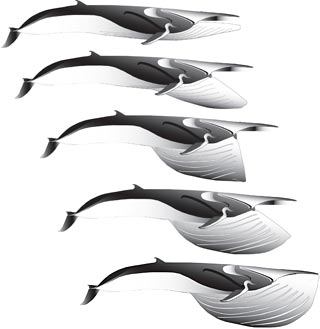 This picture (from the UC Berkeley article) illustrates the "feeding lunge of a fin whale, which can carry the whale some 35 feet and collect as much as 25 pounds of shrimp-like krill." (And these krill, averaging just 1-2 cm in length, are what feeds this 88-foot cetacean.) These whales eat using a series of 6 - 10 second lunges. Perhaps most incredibly, these lunges result the whale taking in enough water that, for those few seconds before the water is filtered out, the whale can be more than twice its normal body weight.
This process take a lot of energy for an animal swimming in the sea. Although each lunge takes them up to 35 feet through the water, there is a tremendous amount of drag on the animal.
Luckily, some whales can get their daily requirement of kill in just four hours of hunting. Pretty amazing when you consider that many whales can consume 2 tons (4000) pounds of krill each day!
Baleen whale generally have 200-400 overlapping plates hanging from each side of the upper jaw, where you might expect to find teeth. These plates, called baleen, are made of a fingernail-like material called keratin. "During feeding, large volumes of water and food can be taken into the mouth because the pleated grooves in the throat expand. As the mouth closes water is expelled through the baleen plates, which trap the food on the inside near the tongue to be swallowed." (Info from the American Cetacean Society)
This picture (from the UC Berkeley article) illustrates the "feeding lunge of a fin whale, which can carry the whale some 35 feet and collect as much as 25 pounds of shrimp-like krill." (And these krill, averaging just 1-2 cm in length, are what feeds this 88-foot cetacean.) These whales eat using a series of 6 - 10 second lunges. Perhaps most incredibly, these lunges result the whale taking in enough water that, for those few seconds before the water is filtered out, the whale can be more than twice its normal body weight.This process take a lot of energy for an animal swimming in the sea. Although each lunge takes them up to 35 feet through the water, there is a tremendous amount of drag on the animal.
Luckily, some whales can get their daily requirement of kill in just four hours of hunting. Pretty amazing when you consider that many whales can consume 2 tons (4000) pounds of krill each day!
Thursday, December 20, 2007
don't feed the parrots in san francisco
Ferry Park, San Francisco, CA
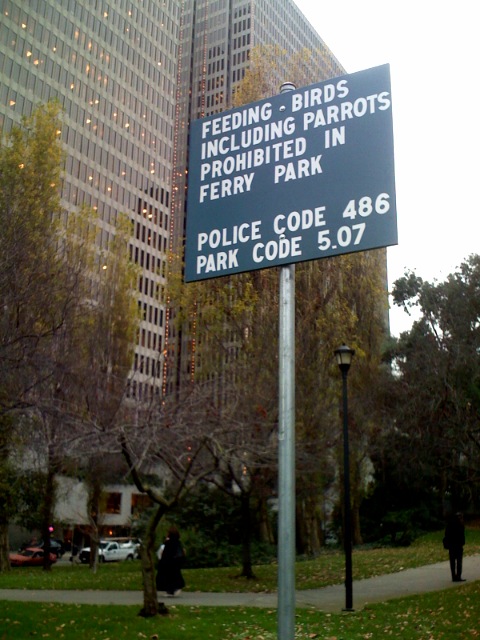
Well, this was not a sign I expected to see in the middle of the city. But it is true - there is a flock of wild parrots that make their home in San Francisco. Actually, there are TWO flocks of birds in the city, but this park is often home to the famous "Wild Parrots of Telegraph Hill." (The scientific name is Aratinga erythrogenys, also known as a cherry-headed conure, among other names.) This species comes from the west side of the Andes in southern Ecuador and the extreme north of Peru.
Resident Mark Bittner maintains a website promoting his book, his film, and general information on these birds. He also was integral in creating this law in 2007, banning the feeding of the birds.
From Bittner's site, I also learned that there is a wild parrot flock in Chicago, Illinois! (First spotted in 1973 in the Hyde Park neighborhood.)
Well, this was not a sign I expected to see in the middle of the city. But it is true - there is a flock of wild parrots that make their home in San Francisco. Actually, there are TWO flocks of birds in the city, but this park is often home to the famous "Wild Parrots of Telegraph Hill." (The scientific name is Aratinga erythrogenys, also known as a cherry-headed conure, among other names.) This species comes from the west side of the Andes in southern Ecuador and the extreme north of Peru.
Resident Mark Bittner maintains a website promoting his book, his film, and general information on these birds. He also was integral in creating this law in 2007, banning the feeding of the birds.
From Bittner's site, I also learned that there is a wild parrot flock in Chicago, Illinois! (First spotted in 1973 in the Hyde Park neighborhood.)
Subscribe to:
Posts (Atom)